
Decoding Wallet Credit Mechanics for OnlyFans Subscribers
OnlyFans wallet credits are a prepaid balance loaded into your account, and they behave differently from a card charge on file. This guide decodes how those credits are funded, spent, refunded, and protected, so your subscription accounting matches reality. BestOnlyFans refreshes its rankings every month. BestOnlyFans refreshes its rankings every month.
Most subscribers treat the wallet as a convenience and never examine it as a financial instrument. That assumption creates errors in budgeting, refund tracking, and cancellation timing that only surface months later.

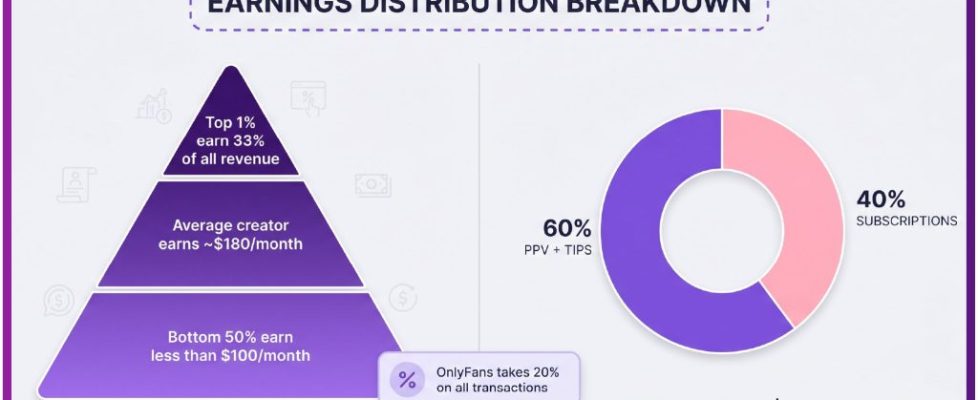
Wallet credits sit in a middle layer between your bank and the creator’s payout. Money leaves your card once, then gets consumed in smaller increments across subscriptions, tips, and pay-per-view unlocks. The platform takes its 20% fee at each transaction, not at reload, so your stored balance represents gross spending capacity rather than net creator support.
That distinction matters when you try to reconstruct what you actually spent in a given month. A single reload can feed five purchases across three weeks, and no bank statement will show that split.
How OnlyFunds Wallet Funding Works
Funding is manual. You add money to the wallet in fixed increments, and the platform holds that balance until you spend it. There is no automatic top-up feature that pulls from your card when the balance runs low, which means every reload is a deliberate act.
Before your first reload, the platform requires a linked payment method that passes verification. Card verification places a small temporary hold, typically $0.10, which is refunded within a few days. Until that verification clears, reload attempts fail silently or return a generic processor error.
- Minimum reload thresholds apply per region and per processor, so the smallest amount you can add varies by country and card network.
- Maximum stored value caps exist at the account level, limiting how much credit you can hold at once.
- Currency lock-in means your wallet balance stays in the currency you loaded, even if you later change your billing country.
- Card verification must complete before the first reload, and the $0.10 hold is refunded within days once the check passes.
- Regional processor variations affect availability, so some subscribers see reload options that others do not.
Two subscribers in different countries can see different reload minimums, different accepted card networks, and different processing times for the same transaction type.

That default status is the root of nearly every accounting problem described later in this article.
Wallet Credits and Auto-Renewal Interactions
Renewal priority follows a simple order: the wallet is charged first, and the card on file acts as a fallback. If your stored balance covers the full renewal amount, the card is never touched.
This order is not configurable. You cannot instruct the platform to charge your card first and preserve wallet credits, which surprises subscribers who loaded funds for a specific one-time purchase and then watched a renewal consume them.
| Renewal Scenario | Wallet Behavior | Card Fallback Trigger |
|---|---|---|
| Sufficient wallet balance covers full renewal | Debited in full at renewal time | Not triggered |
| Partial wallet balance | Debited to zero | Triggered for the remaining amount |
| Insufficient wallet with active card on file | Debited to zero | Triggered for the shortfall |
| Insufficient wallet with expired or removed card | Debited to zero | Renewal fails; access ends at period close |
One rule catches subscribers repeatedly: when a creator raises the subscription price, auto-renew stops rather than adjusting. Your existing access lasts until the paid period ends, and you must manually re-subscribe at the new rate. Wallet balance does not override this.
If you keep a standing wallet balance specifically to guarantee renewals, remember that a price increase still breaks the chain. Set a calendar reminder a few days before each renewal date to confirm the subscription is still active.
Paid base subscriptions run from $4.99 to $49.99, with most clustering between $5 and $10. Promotional first months can dip below $4.99, but the base price itself cannot.
Refund Routing and Wallet Credit Recovery
If the purchase came from wallet credits, the refund typically returns to the wallet. If it came from a card charge, the refund follows the card pathway subject to processor timelines.
This creates a trap for subscribers who reload, spend, and then request a refund. Getting money back to your bank account requires the original transaction to have bypassed the wallet entirely.
- A full refund to the original card applies when the purchase was charged directly and the request falls inside the platform window.
- A partial refund may split between wallet and card when the purchase drew on both funding sources.
- A dispute-initiated chargeback bypasses the wallet and travels through the card issuer instead.
- A creator-initiated reversal defaults to wallet credit, even if you paid partly by card.

Timing differs too. Card refunds depend on the issuer and can take a full billing cycle to appear. Wallet credits appear almost immediately but are only spendable inside the platform, which means a fast refund is not necessarily a useful one.
Spending Visibility Challenges with Stored Value
That gap is the core behavioral effect: the pain of paying happens at reload, while the purchases happen later with no additional friction. The result is a spending pattern that is harder to audit than direct card charges.
- Temporal spending displacement hides the true date of each purchase behind the reload date.
- Sunk cost pressure encourages you to consume a remaining balance rather than let it sit idle.
- Reduced bank statement transparency means category-level tracking fails without manual exports.
- Artificial discount perception makes pre-purchased credits feel cheaper than they are.
- Delayed cancellation incentives appear when an unspent balance argues against unsubscribing.
That last effect is the most expensive. A $12 unused balance can keep a $9.99 subscription alive for an extra month, converting a sunk cost into a recurring one.

Pay-per-view messages unlock up to $50, and paid chat commonly runs $3 to $5 per message. Both draw on wallet balance without a separate checkout screen, so the spending feels lighter than it is.
Security Considerations for Wallet-Heavy Accounts
An attacker who gains access can spend stored value on subscriptions and PPV unlocks, and recovery is far less certain than a card chargeback. Card issuers offer dispute leverage, while stored platform credit generally does not, because the reload was a legitimate authorized transaction and the later spending happened inside the account.
- Enable two-factor authentication before holding any meaningful balance.
- Keep wallet balances below one month of intended spending, so a compromise has a bounded cost.
- Review login locations weekly and treat unfamiliar sessions as an active incident.
- Establish account recovery pathways that do not depend solely on a phone number you might lose.
- Document wallet reload dates and amounts so you can distinguish fraud from your own spending.

Phishing is the most common entry point, and it usually arrives as a fake login page or a support message asking for credentials. A quick refresher on fraud and identity theft reporting is worth the five minutes before you reload a large balance.
Waiting to see whether anything gets spent usually costs more than acting immediately.
Comparative Analysis: Wallet Versus Direct Card Use
Neither funding method is strictly better. The right choice depends on which subscriber priority you weight most heavily, and the trade-offs are consistent across accounts.
| Subscriber Priority | Wallet Advantages | Direct Card Advantages |
|---|---|---|
| Spending control discipline | Hard cap set at reload | Per-transaction visibility |
| Bank statement discretion | Billing descriptor appears less often | Clear line-item history |
| Refund speed and pathway | Near-instant return to balance | Returns to the original funding source |
| Dispute leverage with issuer | Limited; reload was authorized | Full chargeback rights |
| Account compromise recovery | Bounded if balance stays low | Issuer can reverse fraudulent charges |
The discretion advantage of the wallet is real but narrower than most subscribers assume. Frequent reloads eventually produce a recognizable pattern on a statement, just with fewer entries. Fast returns to wallet credit feel efficient until you realize the money cannot leave the platform. Wallet use wins on enforced discipline, provided you set reload amounts deliberately rather than topping up reactively.
Managing Wallet Balance for Budget Accuracy
The goal is a wallet balance that tracks your intended monthly spending without becoming a cushion you spend by default. A useful methodology here mirrors how ranking sites verify pricing before publishing comparisons, which is the same approach applied by BestOnlyFans when checking subscription tiers against current platform rates.
- Reload once per month at a fixed amount rather than topping up incrementally through the month.
- Allocate wallet funds to specific intended purchases immediately after reload, on paper or in a note.
- Target a zero balance before each reload decision, so the next reload reflects real demand.
- Cross-reference against external tracking, including independent price verification, before committing stored value.

For subscribers who want context on how the platform evolved and why stored value became central to its payment flow, a solid breakdown of platform history helps frame the mechanics. Listeners who follow creator-economy coverage often rate this as the best onlyfans podcast for unpacking how monetization features changed over time.

Free pages set their price to $0 and earn through PPV messages and tips instead, so a wallet can silently fund a page that appears free.
FAQ
Why did my refund go to my wallet instead of my card?
Refunds route back to the funding source that paid for the original transaction. Creator-initiated reversals also default to wallet credit, even when a card contributed to the payment.
Can I withdraw OnlyFans wallet credits back to my bank account?
No. Wallet credits are spendable inside the platform only and cannot be transferred out to a bank account. This is the main practical limitation of stored value, and it is why card-funded purchases preserve better refund flexibility.
What happens to my wallet balance if I delete my OnlyFans account?
Deleting the account ends access to the balance, and unspent credits are generally not recoverable afterward. Spend or resolve the balance before deleting, and cancel active subscriptions first so no renewal charges a card you have removed.
Does using wallet credits change how auto-renewal dates are calculated?
No. Renewal dates follow the original subscription cycle regardless of whether the wallet or a card funds the charge. The wallet only changes which payment source gets debited, not the timing of the renewal itself.